


Introduction
If you have ever wondered how websites and web applications work behind the scenes, you have probably come across the terms Front-End vs Back-End Development Explained. These two areas of web development work together to create modern websites that are visually appealing, functional, secure, and easy to use. Whether you are browsing an online store, reading a blog, or using a social media platform, both front-end and back-end technologies play an important role in delivering a smooth experience.
For beginners, understanding the difference between front-end and back-end development can seem confusing at first. Both involve coding, problem-solving, and creating digital experiences, but they focus on different parts of a website. Front-end developers build everything users can see and interact with, while back-end developers create the systems that power those visible features behind the scenes.
Learning Front-End vs Back-End Development Explained is valuable for anyone interested in web development, programming, or digital careers. It helps you choose the right learning path, understand how websites are built, and communicate better with developers if you work in technology-related fields.
In this guide, you will discover what front-end and back-end development are, why they matter, how they work together, their advantages and disadvantages, common mistakes beginners make, expert tips, and answers to frequently asked questions. By the end, you will clearly understand which path matches your interests and career goals.
What is Front-End vs Back-End Development Explained?
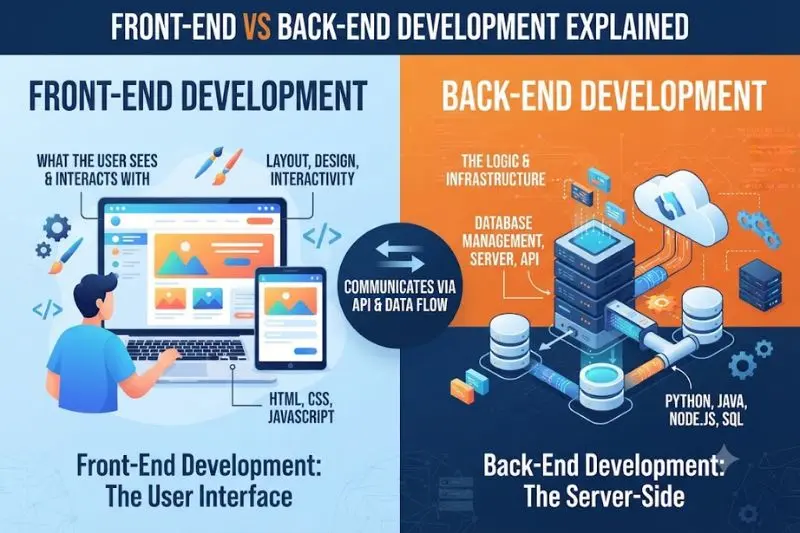
Front-end and back-end development are the two major parts of web development. Although they serve different purposes, they work together to build complete websites and web applications.
What Is Front-End Development?
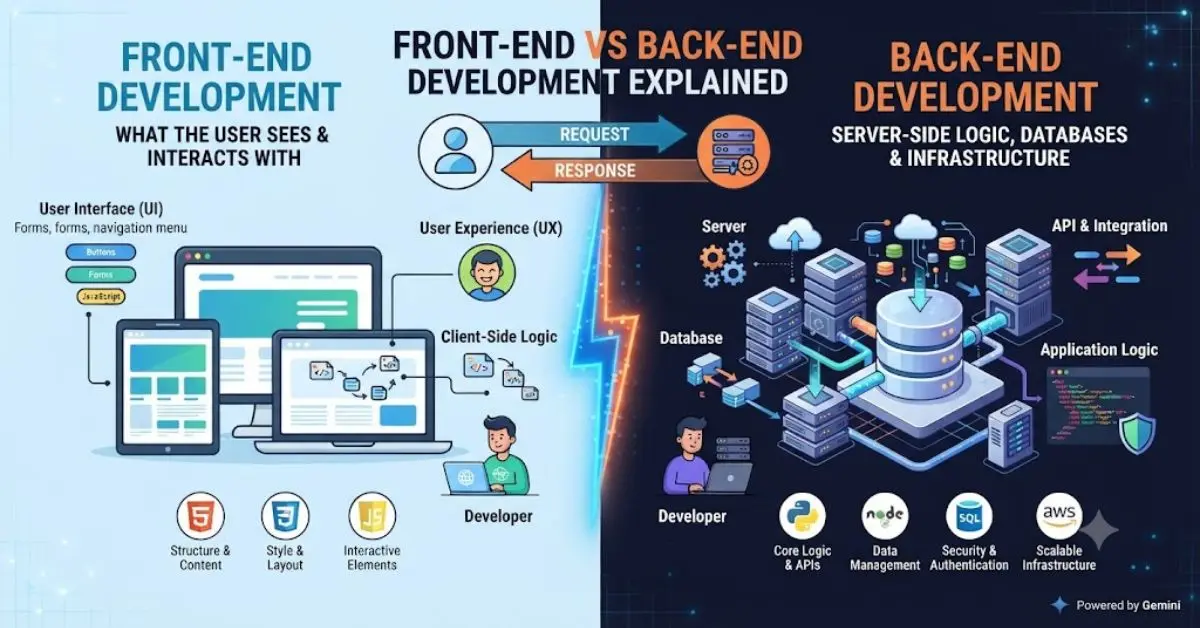
Front-end development focuses on everything visitors see and interact with on a website. It includes layouts, colors, navigation menus, buttons, forms, animations, and responsive designs. The goal is to create an attractive and user-friendly interface.
A front-end developer ensures that a website looks professional and functions properly across desktops, tablets, and smartphones. Their work directly affects user experience because visitors interact with the front end every time they use a website.
The three core technologies used in front-end development include:
- HTML for creating the structure of web pages.
- CSS for styling and designing elements.
- JavaScript for adding interactive features.
Modern front-end developers also use frameworks and libraries that speed up development and improve performance.
Some popular front-end technologies include:
- React
- Vue.js
- Angular
- Bootstrap
- Tailwind CSS
- Sass
For example, when you click a navigation button, view product images, or fill out a registration form, you are interacting with the front end.
What Is Back-End Development?
Back-end development focuses on the server side of a website. It handles everything users cannot see but depends on for proper functionality.
The back end manages databases, authentication, application logic, server communication, and security. Whenever information is stored, updated, or retrieved, the back-end system performs the necessary operations.
For example, when you log into your account, place an online order, or submit a contact form, the back-end system processes your request and returns the appropriate response.
Common back-end programming languages include:
- PHP
- Python
- Java
- JavaScript (Node.js)
- Ruby
- C#
Popular back-end frameworks include:
- Laravel
- Django
- Express.js
- Spring Boot
- Ruby on Rails
- ASP.NET Core
Databases commonly used with back-end development include:
- MySQL
- PostgreSQL
- MongoDB
- SQLite
- Microsoft SQL Server
Without back-end development, websites would simply display static pages without allowing users to log in, save information, process payments, or interact with dynamic content.
How Front-End and Back-End Work Together
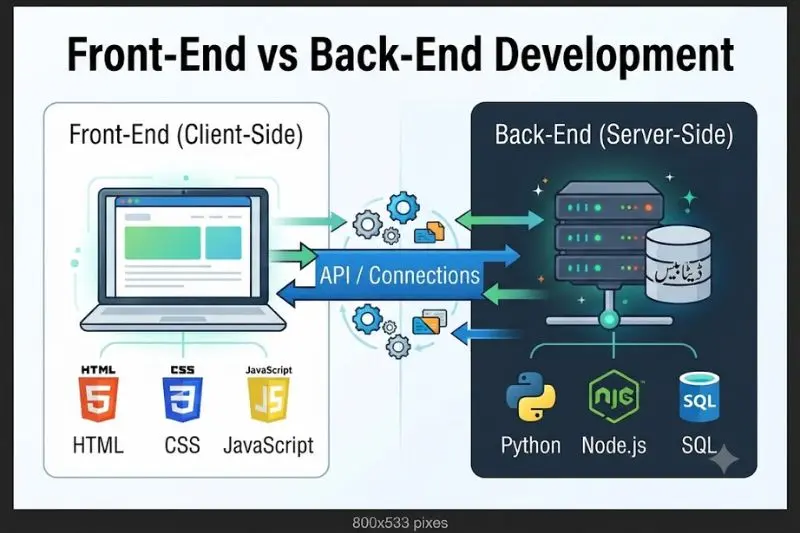
The front end and back end communicate continuously whenever users perform actions on a website.
For example, imagine someone logging into an online shopping website:
- The front end displays the login page.
- The user enters an email address and password.
- The front end sends this information to the server.
- The back end checks the database.
- If the credentials are correct, the server returns approval.
- The front end displays the user’s dashboard.
This seamless communication happens within seconds and creates a smooth user experience.
Why is Front-End vs Back-End Development Important?
Understanding Front-End vs Back-End Development Explained helps developers, business owners, and students appreciate how modern websites function. Every successful website depends on both areas working together efficiently.
Here are several reasons why both are equally important.
Better User Experience
The front end determines how users feel while interacting with a website. Clean layouts, fast loading pages, readable typography, and responsive design encourage visitors to stay longer and engage with content.
A poorly designed interface often leads to higher bounce rates, even if the back end works perfectly.
Strong Website Functionality
The back end powers essential website features such as:
- User accounts
- Payment processing
- Database management
- Search functionality
- Content management
- Order tracking
Without these systems, websites cannot provide meaningful services.
Improved Website Security
Sensitive information like passwords, payment details, and customer records must be protected.
Back-end developers implement security measures such as:
- User authentication
- Data encryption
- Secure APIs
- Access control
- Database protection
These measures help prevent unauthorized access and cyber threats.
Faster Website Performance
Performance depends on both front-end optimization and efficient server-side processing.
Front-end developers optimize images, stylesheets, and scripts to reduce loading times. Meanwhile, back-end developers improve database queries, caching, and server performance.
Together, they create websites that load quickly and respond efficiently.
Better Collaboration
Understanding the differences between front-end and back-end development improves teamwork.
Designers, developers, project managers, and business owners communicate more effectively when everyone understands each role and responsibilities.
Greater Career Opportunities
Web development remains one of the fastest-growing technology fields.
People who understand Front-End vs Back-End Development Explained can pursue careers such as:
- Front-End Developer
- Back-End Developer
- Full-Stack Developer
- Web Application Developer
- UI Developer
- Software Engineer
Companies across industries actively seek professionals with these skills because every modern business depends on web technology.
Detailed Step-by-Step Guide
Step 1: Understand the Basics of Web Development
Before choosing between front-end and back-end development, it is important to understand how websites function as complete systems.
Every website consists of three main layers:
- The presentation layer that users see.
- The application layer that processes requests.
- The database layer that stores information.
Front-end development primarily focuses on the presentation layer, while back-end development manages the application and database layers.
Learning this foundation makes it much easier to understand how different technologies connect to build modern websites.
Step 2: Learn Front-End Development Fundamentals
If you enjoy designing interfaces and creating interactive experiences, front-end development is an excellent starting point. It focuses on everything users can see and interact with in a browser.
Begin by learning these core technologies:
HTML
HTML (HyperText Markup Language) provides the structure of every webpage. It defines headings, paragraphs, images, links, tables, forms, and other content.
For example, an online shopping page uses HTML to organize product titles, descriptions, prices, and images into a meaningful structure.
CSS
CSS (Cascading Style Sheets) controls the appearance of HTML elements. It handles colors, fonts, layouts, spacing, animations, and responsive design.
A well-designed website uses CSS to create a clean layout that works across desktops, tablets, and smartphones.
JavaScript
JavaScript adds functionality and interactivity. It allows websites to respond to user actions without reloading the page.
Examples include:
- Dropdown menus
- Image sliders
- Interactive forms
- Live search suggestions
- Pop-up windows
- Shopping cart updates
After mastering these basics, many developers move on to modern frameworks that simplify complex projects.
Popular front-end frameworks and libraries include:
- React
- Vue.js
- Angular
- Bootstrap
- Tailwind CSS
These tools improve productivity while making websites more responsive and maintainable.
Step 3: Learn Back-End Development Fundamentals
Back-end development focuses on the logic that powers websites behind the scenes.
A back-end developer writes code that communicates with servers, processes user requests, manages databases, and ensures website security.
Popular programming languages include:
- Python
- PHP
- Java
- Node.js
- Ruby
- C#
Each language has strengths depending on the type of application being developed.
For example:
- Python is popular for web applications and automation.
- PHP powers many content management systems.
- Node.js allows JavaScript to run on the server.
- Java is widely used for enterprise software.
Choosing one language and mastering it is often better than learning several at once.
Step 4: Understand Databases
Websites store information inside databases.
Whenever users create accounts, submit forms, purchase products, or write comments, the data must be stored securely.
Common databases include:
- MySQL
- PostgreSQL
- MongoDB
- SQLite
For example, an online bookstore stores:
- Customer information
- Product details
- Inventory
- Orders
- Payment records
The back end communicates with these databases whenever information needs to be added, updated, deleted, or retrieved.
Step 5: Learn How Servers Work
A server is a computer that stores websites and delivers content when users visit them.
Here’s a simplified workflow:
- A visitor opens a website.
- The browser sends a request.
- The server receives the request.
- The back end processes the information.
- The database returns data if needed.
- The server sends the response.
- The browser displays the webpage.
Understanding this process helps developers troubleshoot performance and connectivity issues more effectively.
Step 6: Learn APIs
APIs (Application Programming Interfaces) allow different software systems to communicate.
For example:
- A weather website retrieves forecast data from a weather API.
- A payment gateway connects through an API.
- A travel website fetches airline information from external services.
Front-end developers use APIs to display dynamic content, while back-end developers build APIs that other applications can access.
Step 7: Practice with Real Projects
Theory alone is not enough.
Build practical projects such as:
- Personal portfolio website
- Blog platform
- To-do list application
- Weather application
- Online store
- Restaurant website
- Student management system
These projects strengthen problem-solving skills and create a portfolio for future job opportunities.
Benefits of Front-End vs Back-End Development
Both development paths offer significant advantages.
Front-End Development Benefits
- Creates attractive user interfaces.
- Improves user experience.
- Makes websites responsive across devices.
- Encourages creativity.
- Offers strong career demand.
- Provides opportunities for freelance work.
- Supports rapid visual improvements.
Back-End Development Benefits
- Powers website functionality.
- Handles large amounts of data.
- Improves website security.
- Supports scalability.
- Enables automation.
- Integrates third-party services.
- Maintains business operations.
Combined Benefits
Developers who understand both areas can become full-stack developers and enjoy several additional advantages.
These include:
- Higher earning potential
- Greater flexibility
- Better collaboration
- Faster project completion
- Broader technical knowledge
- Increased job opportunities
Disadvantages / Risks
Every specialization comes with challenges.
Front-End Development Challenges
- Browser compatibility issues.
- Frequent technology updates.
- Responsive design complexity.
- Performance optimization requirements.
- Constant learning of new frameworks.
Back-End Development Challenges
- Complex server management.
- Database optimization difficulties.
- Security vulnerabilities.
- Higher debugging complexity.
- Heavy responsibility for application stability.
General Risks
- Poor communication between teams.
- Slow website performance.
- Security breaches.
- Outdated technologies.
- Inadequate testing.
- Scalability problems.
Fortunately, these challenges become easier to manage with experience and continuous learning.
Common Mistakes to Avoid
Beginners often repeat similar mistakes while learning web development.
Ignoring HTML Fundamentals
Many learners jump directly into frameworks without mastering HTML.
Strong HTML knowledge makes every future technology easier to understand.
Neglecting CSS Basics
Copying styles without understanding layout systems often creates problems later.
Learn:
- Flexbox
- Grid
- Responsive design
- Positioning
- Media queries
These skills form the foundation of professional front-end development.
Learning Too Many Languages at Once
Trying to master HTML, CSS, JavaScript, Python, PHP, Java, and React simultaneously can become overwhelming.
Instead, focus on one learning path before expanding your skills.
Forgetting Security
Back-end developers must never ignore:
- Password encryption
- Input validation
- Authentication
- Authorization
- SQL injection prevention
Security should be considered from the beginning of every project.
Avoiding Practice
Reading tutorials alone does not create experience.
The best developers spend time building real applications and solving practical problems.
Not Using Version Control
Learning Git early helps manage projects, track changes, and collaborate with other developers.
It is one of the most valuable skills in modern software development.
FAQs
What is the main difference between front-end and back-end development?
he main difference is that front-end development focuses on the visual and interactive parts of a website, while back-end development handles the server, database, and application logic that users cannot see.
For example, when you click a “Buy Now” button, the front end displays the button and responds to your click, while the back end processes your order, updates inventory, and stores your payment information securely
Which is easier to learn, front-end or back-end development?
For most beginners, front-end development is easier because you can immediately see the results of your work in a web browser. Learning HTML and CSS is generally more straightforward than understanding servers, databases, and application logic.
However, the best choice depends on your interests. If you enjoy designing user interfaces, front-end development may be a better fit. If you enjoy solving logical problems and working with data, back-end development may be more rewarding.
Can one person learn both front-end and back-end development?
Yes. A developer who understands both areas is known as a full-stack developer. Full-stack developers can build complete web applications from start to finish, making them highly valuable in the technology industry.
Although learning both takes time, starting with one area and gradually expanding your skills is an effective approach.
Which programming languages should beginners learn first?
For front-end development, start with:
HTML
CSS
JavaScript
For back-end development, choose one language such as:
Python
PHP
JavaScript (Node.js)
Java
Mastering the fundamentals before moving to frameworks will make future learning much easier
Is back-end development more difficult than front-end development?
Back-end development often involves more complex concepts, including server management, databases, security, and application architecture. However, front-end development also presents challenges such as responsive design, accessibility, browser compatibility, and performance optimization.
Both fields require continuous learning and practice.
Which career has better job opportunities?
Both front-end and back-end developers are in high demand. Businesses of every size need professionals who can build and maintain websites and web applications.
Developers with strong skills, practical experience, and an impressive portfolio usually have excellent career prospects. Full-stack developers often enjoy even broader employment opportunities because they can contribute to multiple areas of a project
Expert Tips & Bonus Points
Whether you choose front-end or back-end development, following proven strategies can help you progress more quickly and confidently.
- Master the fundamentals before learning advanced frameworks.
- Build real-world projects instead of relying only on tutorials.
- Write clean, organized, and readable code.
- Learn debugging techniques to solve problems efficiently.
- Practice responsive web design from the beginning.
- Understand basic cybersecurity concepts, even if you focus on front-end development.
- Learn Git and version control to manage projects effectively.
- Read other developers’ code to discover new techniques and best practices.
- Keep a portfolio that showcases your strongest work.
- Stay updated with industry trends, but avoid chasing every new technology.
- Focus on understanding concepts rather than memorizing code.
- Practice consistently, even if you only have a short amount of time each day.
- Join developer communities to ask questions, share knowledge, and receive constructive feedback.
- Improve your communication skills, as successful developers often work closely with designers, project managers, and clients.
- Remember that patience and persistence are essential. Every experienced developer started as a beginner and improved through continuous learning and hands-on experience.
By applying these tips, you will build a solid foundation that supports long-term growth and opens the door to exciting opportunities in web development.
Conclusion
Understanding Front-End vs Back-End Development Explained is one of the most important steps for anyone interested in building websites or pursuing a career in web development. Although these two disciplines have different responsibilities, they work together to create fast, secure, and engaging digital experiences. Front-end development focuses on everything users see and interact with, while back-end development powers the functionality, databases, and server-side operations that make those interactions possible.
Choosing between front-end and back-end development depends on your interests and strengths. If you enjoy creativity, design, and user experience, front-end development may be the right path. On the other hand, if you prefer problem-solving, databases, and application logic, back-end development could be a better fit. There is also the option of becoming a full-stack developer by learning both skill sets over time.
The technology landscape continues to evolve, making web development one of the most exciting and rewarding career fields. By mastering the fundamentals, practicing with real projects, avoiding common mistakes, and staying committed to continuous learning, you can build valuable skills that remain relevant for years to come.
Whether your goal is to create personal websites, develop business applications, freelance, or work for leading technology companies, a strong understanding of front-end and back-end development provides a solid foundation for success. Start with the basics, keep building projects, and embrace every opportunity to learn. Consistent practice and curiosity will help you grow into a confident and capable web developer.
