


Introduction
On-Page SEO Best Practices are the foundation of every successful website. Whether you own a blog, an online store, or a business website, optimizing each page correctly helps search engines understand your content while providing visitors with a better experience.
Unlike off-page SEO, which focuses on backlinks and external signals, on-page SEO deals with everything you can control directly on your website. This includes writing high-quality content, creating optimized title tags, improving page speed, using proper heading structures, adding internal links, and making your website mobile-friendly.
Search engines have become smarter over the years. Instead of rewarding pages that simply repeat keywords, they now prioritize content that is useful, trustworthy, and easy to read. This means website owners need to focus on both technical optimization and user experience.
If you are new to SEO or want to improve your existing strategy, learning On-Page SEO Best Practices can significantly increase your chances of ranking higher in search results. When implemented correctly, these practices help attract targeted visitors, improve engagement, and increase conversions over time.
This guide explains everything you need to know, from the basics to advanced optimization techniques, making it suitable for beginners and intermediate users alike.
What is On-Page SEO Best Practices?
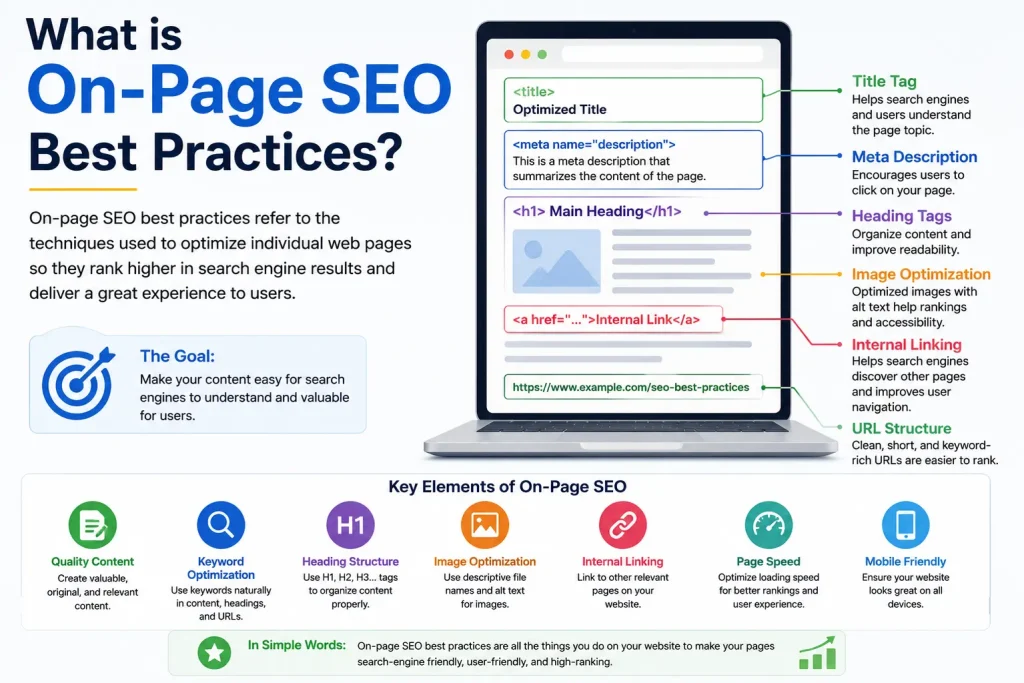
On-page SEO refers to the process of optimizing individual web pages so they perform better in search engine results. Every element on a page contributes to its ability to rank, including content, HTML tags, images, URLs, and internal links.
The goal is to make each page valuable for readers while helping search engines understand its topic clearly.
On-page SEO includes:
- Writing informative and original content
- Optimizing page titles
- Creating compelling meta descriptions
- Using keywords naturally
- Structuring headings correctly
- Improving page loading speed
- Optimizing images
- Building internal links
- Making pages mobile-friendly
- Enhancing user experience
Unlike technical SEO, which focuses on website infrastructure, on-page SEO concentrates on the content and elements visible on each page.
Why is On-Page SEO Best Practices Important?
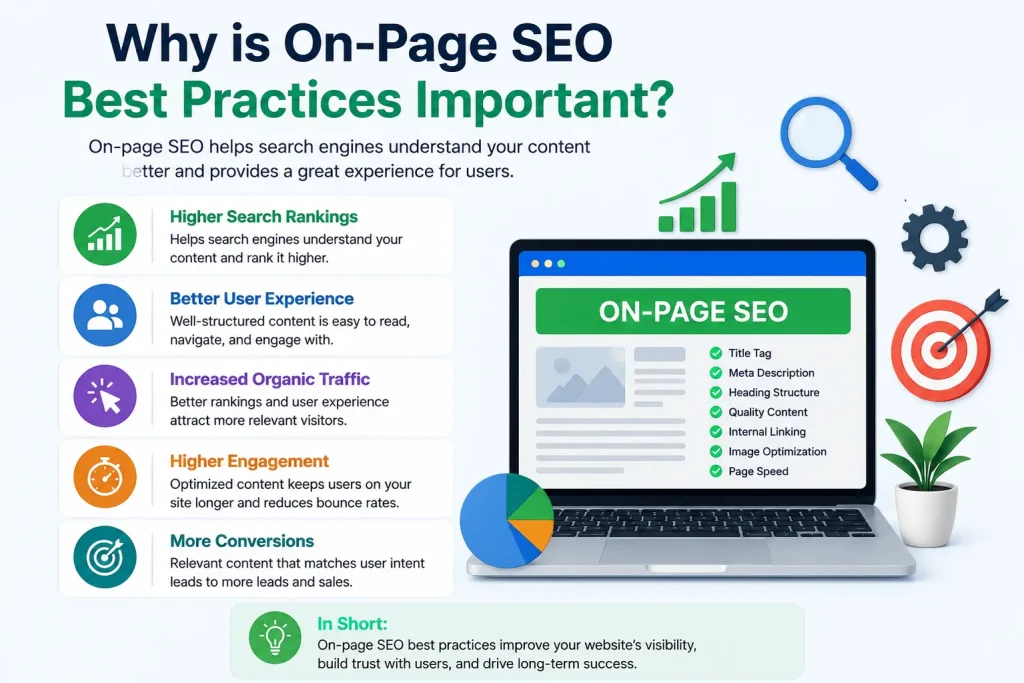
Effective on-page optimization provides long-term benefits for both search engines and users.
Some of the biggest reasons include:
- Helps search engines understand your content
- Improves keyword relevance
- Increases organic traffic
- Creates a better user experience
- Reduces bounce rates
- Encourages longer page visits
- Builds website authority
- Supports higher conversion rates
- Makes content easier to navigate
- Improves accessibility across devices
Without proper on-page optimization, even excellent content may struggle to rank well.
Detailed Step-by-Step Guide
Step 1: Perform Proper Keyword Research
Keyword research is the starting point of every SEO campaign.
Focus on:
- Primary keywords
- Secondary keywords
- Long-tail keywords
- Search intent
- User questions
For example, instead of targeting only “SEO,” consider phrases like “on-page SEO checklist for beginners.”
Step 2: Create High-Quality Content
Content remains the most important ranking factor.
High-quality content should:
- Answer user questions completely
- Be easy to understand
- Include examples
- Stay updated
- Offer unique insights
- Avoid duplicate information
Aim to solve readers’ problems rather than simply filling pages with text.
Step 3: Optimize Your Title Tag
The title tag is often the first thing users see in search results.
A strong title should:
- Include the primary keyword
- Stay under 60 characters
- Be clear
- Encourage clicks
- Match search intent
Example:
On-Page SEO Best Practices: Complete Beginner’s Guide
Step 4: Write an Effective Meta Description
Although meta descriptions do not directly affect rankings, they improve click-through rates.
A good description should:
- Be under 155 characters
- Include the main keyword
- Explain page value
- Encourage users to click
Step 5: Use Proper Heading Structure
Organize your content with:
- H1 for the title
- H2 for main sections
- H3 for subtopics
- H4 when necessary
This improves readability and helps search engines understand content hierarchy.
Step 6: Optimize URLs
Keep URLs:
- Short
- Descriptive
- Easy to read
- Keyword-focused
Example:
example.com/on-page-seo-best-practices
Avoid unnecessary numbers or random characters.
Step 7: Use Keywords Naturally
Avoid keyword stuffing.
Instead:
- Place keywords naturally
- Include synonyms
- Use related phrases
- Write for readers first
Search engines now understand context better than ever.
Step 8: Improve Internal Linking
Internal links help visitors discover related content.
Benefits include:
- Better navigation
- Improved crawling
- Increased page authority
- Longer session duration
Link only when relevant.
Step 9: Optimize Images
Images improve engagement but should also be optimized.
Best practices include:
- Compress image size
- Use descriptive filenames
- Add alt text
- Choose appropriate formats
- Avoid oversized files
Optimized images improve loading speed and accessibility.
Step 10: Improve Page Speed
Fast websites rank better and provide a better experience.
Improve speed by:
- Compressing images
- Minimizing CSS
- Reducing JavaScript
- Using browser caching
- Choosing reliable hosting
- Enabling compression
Every second saved can improve user satisfaction.
Step 11: Make Your Website Mobile-Friendly
Most users browse on smartphones.
Ensure your website:
- Uses responsive design
- Has readable text
- Features clickable buttons
- Loads quickly
- Displays correctly on different screen sizes
Mobile usability is essential for modern SEO.
Step 12: Improve User Experience
User experience influences rankings indirectly.
Focus on:
- Clear navigation
- Readable fonts
- Logical layouts
- Helpful visuals
- Easy scanning
- Fast interactions
Visitors who enjoy using your website are more likely to stay longer.
Step 13: Optimize for Search Intent
Understand why users search.
Content should match intent:
- Informational
- Navigational
- Commercial
- Transactional
Meeting user expectations increases satisfaction and rankings.
Step 14: Add Structured Data
Schema markup helps search engines better understand your pages.
It may improve search visibility through rich results such as:
- FAQs
- Reviews
- Products
- Recipes
- Articles
While not mandatory, structured data provides additional context.
Step 15: Regularly Update Content
SEO is an ongoing process.
Update pages by:
- Refreshing statistics
- Adding new examples
- Fixing outdated information
- Improving readability
- Expanding useful sections
Fresh content signals relevance.
Benefits of On-Page SEO Best Practices
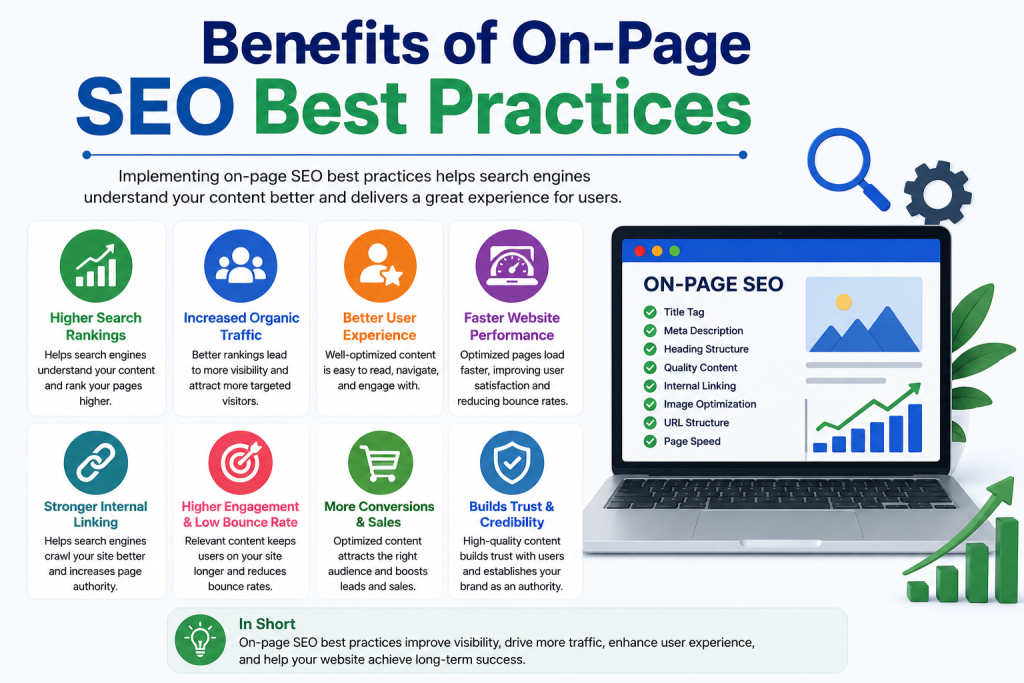
Implementing strong on-page SEO offers numerous advantages.
- Higher search engine rankings
- Increased organic traffic
- Better user experience
- Faster website performance
- Higher click-through rates
- Improved engagement
- More qualified visitors
- Stronger brand authority
- Better content organization
- Increased conversion opportunities
- Lower bounce rates
- Improved mobile usability
- Easier website maintenance
- Long-term SEO growth
- Greater visibility for important pages
Disadvantages / Risks
Although highly beneficial, poor implementation can create problems.
Potential risks include:
- Keyword stuffing
- Duplicate content
- Slow-loading pages
- Over-optimized anchor text
- Thin content
- Poor internal linking
- Broken images
- Excessive ads
- Ignoring mobile optimization
- Outdated content
- Confusing navigation
- Weak page structure
Fortunately, these issues can be avoided with regular audits.
Common Mistakes to Avoid
Many beginners unknowingly reduce their SEO performance.
Avoid these common mistakes:
- Publishing low-quality content
- Ignoring search intent
- Missing title tags
- Forgetting meta descriptions
- Using duplicate titles
- Writing overly long paragraphs
- Skipping image optimization
- Neglecting internal links
- Overusing keywords
- Ignoring page speed
- Not updating old articles
- Creating confusing URLs
- Using multiple H1 headings
- Forgetting mobile optimization
- Publishing without proofreading
Small improvements often produce significant results
What is the difference between on-page SEO and off-page SEO?
On-page SEO focuses on optimizing elements within your website, including content, headings, images, and HTML tags. Off-page SEO involves activities outside your website, such as earning backlinks, brand mentions, and social signals.
How often should I update my pages?
Review important pages every few months. Update outdated information, improve readability, add fresh examples, and expand valuable sections whenever needed.
Does keyword density still matter?
Not as much as it once did. Modern search engines prioritize context, relevance, and content quality over repeating the same keyword multiple times.
Why are internal links important?
Internal links help search engines crawl your website more effectively while guiding users toward additional helpful content. They also distribute authority across important pages.
How important is mobile optimization?
It is extremely important. Since most searches occur on mobile devices, responsive design and fast loading are essential for both rankings and user satisfaction.
Can I rank without backlinks if my on-page SEO is excellent?
Strong on-page SEO can help pages rank, especially for less competitive keywords. However, backlinks remain an important ranking factor for highly competitive search terms.
Expert Tips & Bonus Points
To maximize your results, keep these professional recommendations in mind:
- Write for people before search engines.
- Focus on solving real user problems.
- Keep paragraphs short and readable.
- Use descriptive headings throughout the page.
- Include relevant images where appropriate.
- Add comparison tables when useful.
- Refresh older articles regularly.
- Monitor page performance using analytics.
- Improve pages with high impressions but low click-through rates.
- Create content clusters around related topics.
- Maintain consistent formatting across your website.
- Test different title variations to improve clicks.
- Remove outdated or thin content that no longer provides value.
- Ensure every page has a clear purpose and call to action.
Successful SEO comes from continuous improvement rather than one-time optimization.
Conclusion
Mastering On-Page SEO Best Practices is one of the most effective ways to build a website that performs well in search engines while delivering genuine value to visitors. Every optimization, from writing useful content and organizing headings to improving page speed and creating meaningful internal links, contributes to stronger visibility and better user engagement.
SEO is not about finding shortcuts or relying on outdated tactics. Instead, it requires understanding what your audience needs and presenting information in a clear, organized, and accessible way. Search engines reward websites that consistently provide accurate, relevant, and high-quality experiences.
As you implement these practices, remember that results rarely happen overnight. Regularly review your pages, update outdated information, monitor performance, and continue refining your strategy. Even small improvements made consistently can produce significant long-term gains in rankings and organic traffic.
Whether you manage a personal blog, a business website, or an online store, applying these proven techniques will help you create pages that are easier to discover, more enjoyable to read, and more likely to convert visitors into loyal readers or customers. By focusing on quality, usability, and continuous optimization, you can build a strong foundation for sustainable SEO success that supports your website’s growth for years to come.
