



Introduction
If you want your website to appear on the first page of search engines, mastering Keyword Research Guide for Better Rankings is one of the most important skills you can develop. No matter how valuable your content is, it will struggle to attract visitors if it targets the wrong keywords. Effective keyword research helps you understand what your audience is searching for, allowing you to create content that matches their needs and search intent.
Many beginners assume keyword research is simply about finding popular search terms. In reality, it involves analyzing search volume, competition, user intent, trends, and relevance to your niche. When done correctly, keyword research becomes the foundation of every successful SEO strategy. It guides content creation, improves organic traffic, and increases the likelihood of ranking for valuable search queries.
Whether you own a blog, manage an online store, or run a business website, learning how to research keywords properly can significantly improve your online visibility. Instead of guessing what people want, you can rely on real search data to make informed decisions. This approach saves time, improves content quality, and increases long-term results.
This Keyword Research Guide for Better Rankings explains everything from the basics to advanced techniques. By following the steps outlined below, you’ll learn how to discover profitable keywords, organize them effectively, and build an SEO strategy that attracts consistent organic traffic.
What is Keyword Research Guide for Better Rankings?
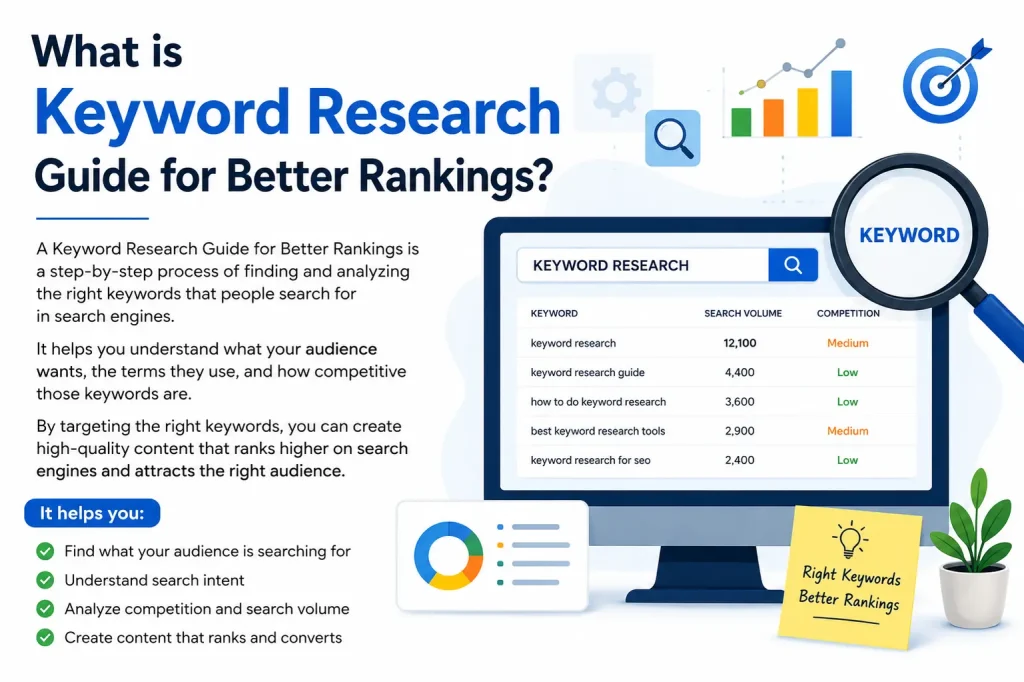
Keyword research is the process of identifying the words and phrases people type into search engines when looking for information, products, or services. These keywords help website owners understand audience interests and create content that answers their questions.
A proper Keyword Research Guide for Better Rankings goes beyond collecting random keywords. It focuses on selecting terms that balance search volume, competition, and user intent. The ultimate goal is to target keywords that are both achievable and valuable.
For example, instead of targeting a broad keyword like “shoes,” a beginner website may target a long-tail keyword such as “best running shoes for beginners.” Although the search volume is lower, competition is also much lower, making it easier to rank.
Keyword research also helps you understand:
- What your audience wants
- How people search online
- Which topics deserve content
- Which keywords drive conversions
- What competitors are ranking for
Without keyword research, creating SEO content becomes little more than guesswork.
Why is Keyword Research Guide for Better Rankings Important?
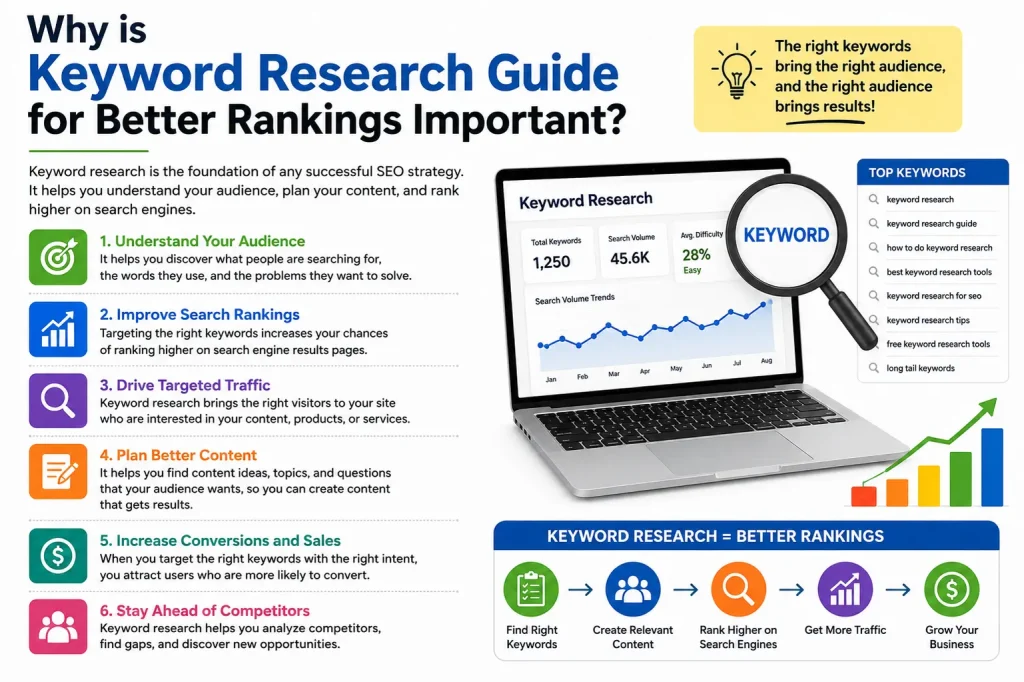
Keyword research influences nearly every aspect of SEO. Choosing the right keywords helps search engines understand your content while connecting you with users actively searching for your information.
Some major reasons include:
- Increases organic website traffic
- Helps rank for relevant search queries
- Improves content planning
- Reveals customer interests
- Identifies market opportunities
- Supports higher conversion rates
- Reduces wasted SEO efforts
- Builds topical authority over time
Instead of producing dozens of articles randomly, keyword research helps prioritize topics that actually have ranking potential.
Detailed Step-by-Step Guide
Step 1: Understand Your Target Audience
Before opening any keyword tool, think about your audience.
Ask questions such as:
- What problems do they have?
- What solutions are they searching for?
- What language do they use?
- Are they beginners or experts?
- What questions do they ask before making a purchase?
Understanding these answers makes keyword selection much easier.
Step 2: Brainstorm Seed Keywords
Seed keywords are broad ideas related to your niche.
For example, if your website focuses on digital marketing, your seed keywords might include:
- SEO
- Keyword research
- Content marketing
- Backlinks
- Technical SEO
- Google rankings
These keywords become the starting point for discovering hundreds of related opportunities.
Step 3: Use Keyword Research Tools
Keyword research tools provide valuable information including:
- Monthly search volume
- Keyword difficulty
- Competition level
- Search trends
- Related keywords
- User questions
Popular tools include free and premium platforms that allow you to compare keyword opportunities before creating content.
Rather than selecting only the highest-volume keywords, focus on finding keywords that combine decent traffic with manageable competition.
Step 4: Understand Search Intent
Search intent explains why someone searches for a keyword.
There are four primary types.
Informational Intent
Users want information.
Examples:
- What is keyword research?
- How does SEO work?
Navigational Intent
Users want a specific website.
Example:
- Google Search Console
Commercial Intent
Users compare products before purchasing.
Examples:
- Best keyword research tools
- SEO software comparison
Transactional Intent
Users are ready to buy.
Examples:
- Buy SEO course
- Keyword research software pricing
Matching content with search intent dramatically improves ranking potential.
Step 5: Analyze Search Volume
Search volume indicates how often a keyword is searched each month.
High search volume may seem attractive, but these keywords usually have intense competition.
New websites often benefit from medium-volume or low-volume long-tail keywords because they offer faster ranking opportunities.
Quality matters more than quantity.
Step 6: Evaluate Keyword Difficulty
Keyword difficulty estimates how challenging it is to rank for a search term.
Factors affecting difficulty include:
- Strong competitors
- Domain authority
- Content quality
- Backlink profiles
- Search intent satisfaction
Beginners should prioritize lower-difficulty keywords while gradually targeting more competitive phrases as website authority grows.
Step 7: Find Long-Tail Keywords
Long-tail keywords usually contain three or more words.
Examples include:
- Best keyword research guide for bloggers
- Keyword research for small businesses
- SEO keyword research tips for beginners
Advantages include:
- Lower competition
- Higher conversion rates
- Better search intent
- Easier rankings
- More targeted visitors
Long-tail keywords often generate more qualified traffic than broad keywords.
Step 8: Study Your Competitors
Competitor analysis reveals valuable keyword opportunities.
Look at:
- Their highest-ranking pages
- Frequently used keywords
- Popular blog topics
- Featured snippets
- FAQ sections
- Internal linking strategy
Instead of copying competitors, identify content gaps and produce better, more comprehensive articles.
Step 9: Group Similar Keywords
Organizing keywords improves content planning.
For example:
Primary Keyword
- Keyword Research Guide for Better Rankings
Related Keywords
- SEO keyword research
- Keyword planning
- Search intent
- Long-tail keywords
- Keyword analysis
- Organic traffic
- Content optimization
This method helps create topical authority while preventing duplicate content.
Step 10: Create High-Quality Content
Keyword research alone does not guarantee rankings.
Your content should:
- Answer user questions
- Be easy to read
- Include useful examples
- Use descriptive headings
- Include bullet points
- Maintain natural keyword placement
- Provide original insights
Search engines reward content that genuinely helps readers solve problems.
Step 11: Optimize On-Page SEO
Once content is written, optimize important SEO elements.
These include:
- SEO title
- Meta description
- URL
- Heading structure
- Image alt text
- Internal links
- External references where appropriate
- Mobile-friendly formatting
Proper optimization increases visibility without overusing keywords.
Step 12: Monitor Performance
SEO is an ongoing process.
Track metrics such as:
- Organic traffic
- Keyword rankings
- Click-through rate
- Bounce rate
- Average session duration
- Conversion rate
Regular analysis helps identify pages that need updates or additional optimization.
Benefits of Keyword Research Guide for Better Rankings
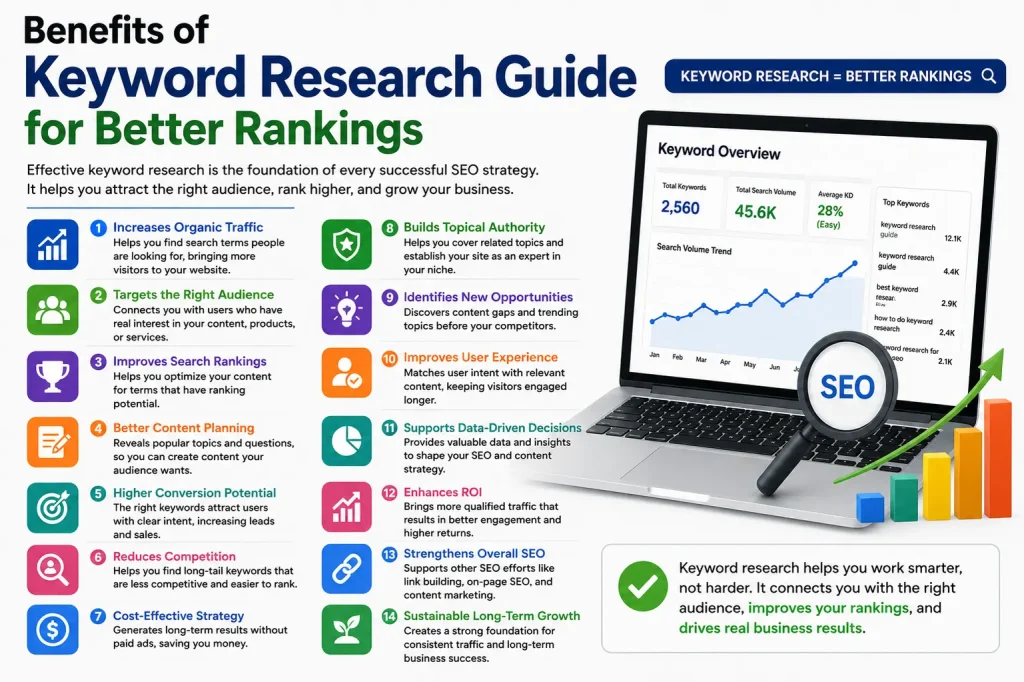
Effective keyword research offers long-term advantages that go beyond improving search rankings. It helps create a focused content strategy, attracts the right audience, and supports sustainable website growth.
Some of the biggest benefits include:
- Increases organic website traffic over time
- Helps target the right audience
- Improves search engine visibility
- Builds topical authority in your niche
- Supports a better content marketing strategy
- Identifies profitable content opportunities
- Reduces competition by targeting long-tail keywords
- Increases click-through rates with relevant content
- Improves user experience by matching search intent
- Helps generate more qualified leads and sales
- Saves time by focusing on keywords with ranking potential
- Provides measurable SEO results
- Strengthens your overall digital marketing strategy
- Helps discover trending topics before competitors
- Creates a structured content calendar
When keyword research becomes part of your regular SEO workflow, every article has a stronger chance of reaching the right audience.
Disadvantages / Risks
Although keyword research is essential, relying on it incorrectly can create challenges. Understanding these risks helps you avoid costly SEO mistakes.
Some common disadvantages include:
- Targeting highly competitive keywords that are difficult to rank for
- Ignoring search intent while focusing only on search volume
- Spending too much time collecting keywords instead of creating content
- Depending entirely on keyword tools without understanding your audience
- Keyword stuffing, which can reduce readability and rankings
- Following outdated keyword trends
- Neglecting content quality in favor of optimization
- Failing to update keyword strategies as search behavior changes
Fortunately, these risks are easy to avoid with regular analysis, high-quality content, and a user-first approach.
Common Mistakes to Avoid
Many beginners unknowingly make mistakes that slow their SEO progress. Avoiding these common issues can significantly improve your results.
Choosing Only High-Volume Keywords
High search volume often comes with intense competition. Instead, balance search volume with keyword difficulty and relevance.
Ignoring User Intent
A keyword may have thousands of searches, but if your content does not satisfy the user’s intent, it is unlikely to rank well or convert visitors.
Keyword Stuffing
Repeating the same keyword excessively makes content difficult to read and may negatively affect search performance. Use your primary keyword naturally and include related terms where appropriate.
Skipping Long-Tail Keywords
Long-tail keywords usually attract visitors with specific needs. These visitors are often more likely to engage with your content or complete a desired action.
Not Analyzing Competitors
Competitor research provides valuable insights into content gaps, ranking opportunities, and successful keyword strategies.
Creating Thin Content
Publishing short or incomplete articles simply to target keywords rarely produces lasting SEO results. Comprehensive, helpful content performs better over time.
Forgetting to Update Old Content
Search trends change. Regularly updating older articles with fresh information and new keywords helps maintain or improve rankings.
Ignoring Analytics
Without tracking keyword rankings and website performance, it is difficult to know what is working and what needs improvement.
What is keyword research in SEO?
Keyword research is the process of finding the search terms people use online. It helps you create content that matches user intent and improves your chances of ranking higher in search engine results.
Why is keyword research important?
Keyword research ensures your content targets topics people are actively searching for. This increases organic traffic, improves visibility, and helps attract the right audience.
What are long-tail keywords?
Long-tail keywords are longer, more specific search phrases. They generally have lower competition and higher conversion potential because they closely match user intent.
Example:
“Best keyword research guide for beginners”
“Affordable SEO tools for small businesses”
How often should I perform keyword research?
Keyword research should be an ongoing process. Reviewing your keyword strategy every few months helps you discover new opportunities, adapt to search trends, and update existing content.
Can I rank without keyword research?
While it is possible for some content to rank naturally, consistent SEO success usually requires proper keyword research. It helps you understand your audience and create content that search engines recognize as relevant.
How many keywords should one article target?
Focus on one primary keyword along with several related secondary keywords. This keeps the article focused while allowing it to rank for multiple relevant search queries naturally.
What is search intent?
Search intent is the reason behind a user’s search. It may be informational, navigational, commercial, or transactional. Understanding search intent helps you create content that satisfies users and improves rankings.
Are free keyword research tools enough?
Free tools are excellent for beginners and can provide valuable keyword ideas. As your website grows, premium tools may offer more detailed data, competitor insights, and advanced filtering options.
Expert Tips & Bonus Points
Experienced SEO professionals follow several best practices that consistently improve keyword research results.
- Always begin with your audience’s problems rather than keywords.
- Prioritize search intent over search volume.
- Build content clusters around related topics to establish authority.
- Include question-based keywords to target featured snippets.
- Analyze competitors regularly for fresh keyword opportunities.
- Update older articles with new keywords and current information.
- Monitor ranking performance and refine your strategy based on real data.
- Use descriptive headings to improve readability and SEO.
- Write naturally for readers first and search engines second.
- Create comprehensive content that fully answers user questions.
- Combine evergreen topics with seasonal content for balanced traffic.
- Maintain a consistent publishing schedule to strengthen topical authority.
One valuable bonus tip is to create a keyword spreadsheet. Organize your primary keywords, secondary keywords, search intent, search volume, competition level, and target pages. This simple habit makes long-term SEO planning much easier.
Conclusion
Keyword research is the cornerstone of every successful SEO strategy. It helps you understand your audience, discover valuable search opportunities, and create content that answers real questions. Instead of relying on guesswork, you can make informed decisions based on search behavior and user intent.
This Keyword Research Guide for Better Rankings has covered the essential concepts, from understanding your audience and selecting seed keywords to analyzing competition, identifying long-tail keywords, optimizing on-page SEO, and monitoring performance. When these techniques are applied consistently, they create a strong foundation for long-term organic growth.
Remember that effective keyword research is not a one-time task. Search trends evolve, competitors publish new content, and user interests change over time. Regularly reviewing your keyword strategy, updating existing articles, and expanding your content around related topics will help maintain and improve your rankings.
Success in SEO comes from combining thoughtful keyword research with high-quality, valuable content that genuinely serves readers. Focus on solving problems, answering questions, and delivering useful information rather than chasing rankings alone. As your website grows in authority and trust, your efforts will lead to increased visibility, higher organic traffic, and stronger online performance. By making keyword research an ongoing part of your content strategy, you can build a website that continues to attract and engage visitors for years to come.
