


Introduction
Building a website is only the first step toward establishing an online presence. The real challenge is attracting visitors who are genuinely interested in your content, products, or services. This is where a SEO Guide for Beginners becomes essential. Search Engine Optimization (SEO) helps your website appear higher in search engine results, making it easier for people to discover your pages naturally without relying entirely on paid advertising.
For beginners, SEO may seem technical and overwhelming because it involves keywords, content creation, website performance, backlinks, and many other factors. However, the good news is that anyone can learn the basics with the right approach. Once you understand how search engines work and what users are looking for, improving your website becomes much easier.
This SEO Guide for Beginners explains the fundamental concepts of SEO in simple language. Whether you own a blog, an online store, or a business website, these proven techniques can help you increase visibility, attract qualified visitors, and build long-term online success. Instead of searching for shortcuts, you’ll learn practical strategies that continue delivering results over time.
What is SEO Guide for Beginners?
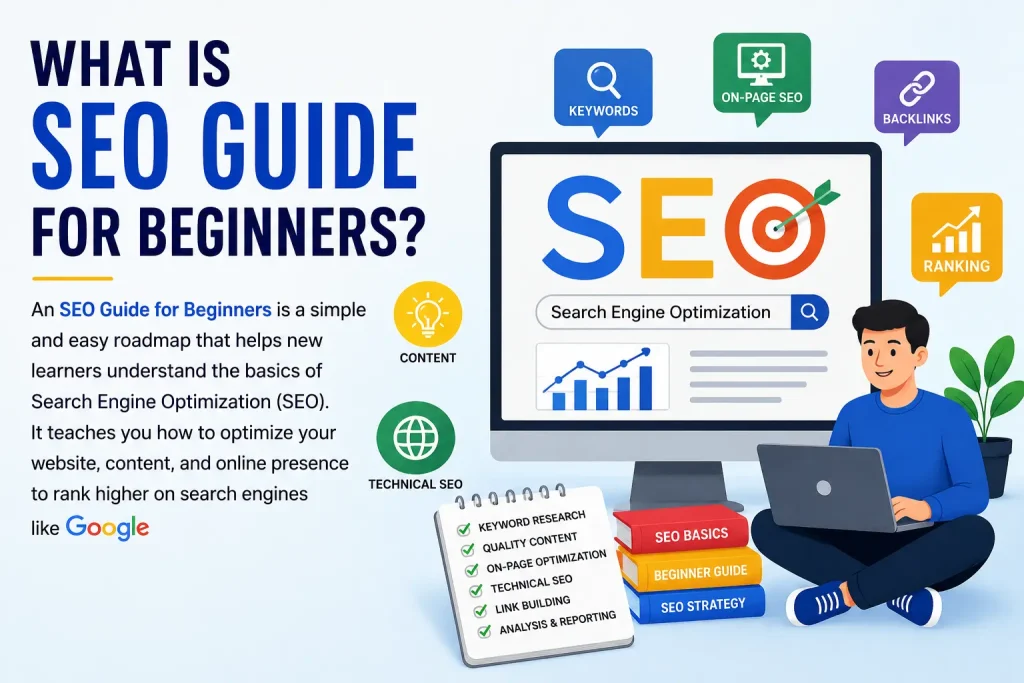
SEO stands for Search Engine Optimization, the process of improving a website so that search engines understand its content and display it to users searching for relevant topics.
A SEO Guide for Beginners introduces the essential techniques needed to optimize websites without requiring advanced technical knowledge.
SEO generally consists of three main areas:
- On-Page SEO: Optimizing content, keywords, titles, headings, and images.
- Off-Page SEO: Building authority through backlinks and brand mentions.
- Technical SEO: Improving website speed, mobile responsiveness, indexing, and crawlability.
Search engines evaluate hundreds of ranking signals before deciding where a webpage should appear in search results. While no one can guarantee the top position, following SEO best practices significantly improves your chances of earning higher rankings.
Why is SEO Guide for Beginners Important?
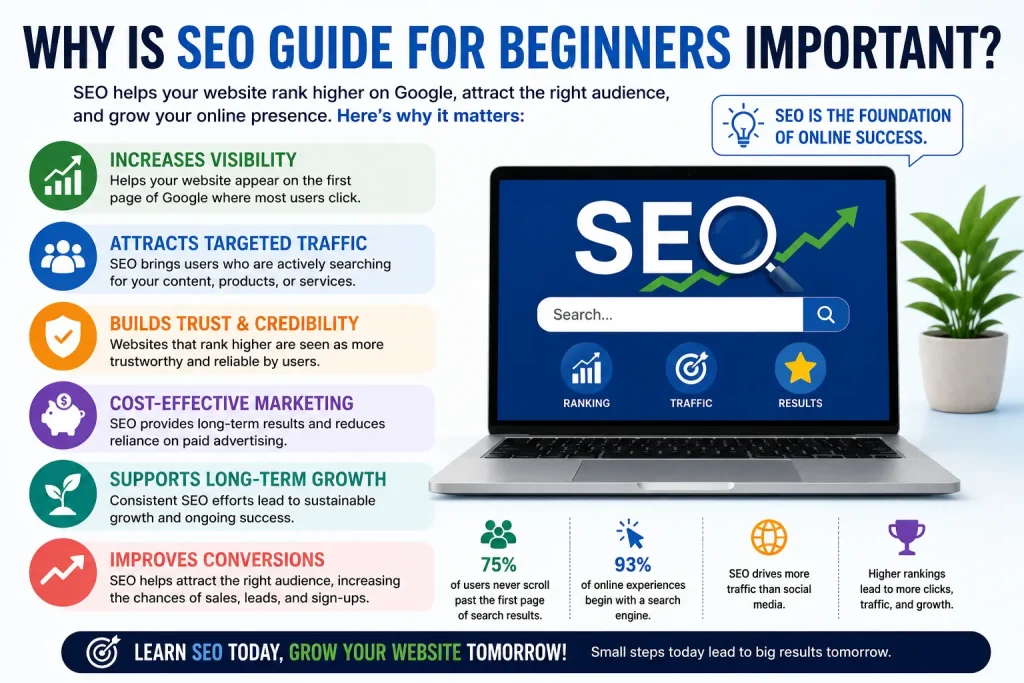
Learning SEO early provides a strong foundation for long-term online growth.
Some important reasons include:
- Increases organic website traffic
- Builds trust and credibility
- Improves user experience
- Generates long-term results
- Reduces advertising costs
- Helps businesses compete online
- Supports brand awareness
- Increases conversions through targeted visitors
Unlike paid advertising, SEO continues delivering value even after content is published and optimized properly.
Detailed Step-by-Step Guide
Step 1: Understand How Search Engines Work
Search engines follow three basic processes:
- Crawling websites
- Indexing pages
- Ranking content
Their goal is to show users the most relevant and useful results for every search query.
Step 2: Perform Keyword Research
Keyword research helps identify what people are searching for online.
Look for keywords that have:
- Good search volume
- Moderate competition
- Clear search intent
- Relevance to your website
Instead of targeting only broad keywords, include long-tail keywords because they often have less competition and higher conversion potential.
Example:
Instead of:
“SEO”
Use:
“SEO Guide for Beginners”
Step 3: Understand Search Intent
Before writing content, determine why users are searching.
Common search intent includes:
- Informational
- Navigational
- Commercial
- Transactional
Matching your content to user intent improves rankings and visitor satisfaction.
Step 4: Create High-Quality Content
Content remains one of the strongest SEO ranking factors.
Your articles should be:
- Original
- Helpful
- Well-structured
- Easy to read
- Updated regularly
Focus on solving problems instead of simply repeating keywords.
Step 5: Optimize Title Tags
The page title should:
- Include your primary keyword
- Be engaging
- Stay under approximately 60 characters
- Encourage clicks
Example:
SEO Guide for Beginners: Learn SEO Step by Step
Step 6: Write Meta Descriptions
Although meta descriptions don’t directly affect rankings, they improve click-through rates.
A good description should:
- Summarize the page
- Include the keyword naturally
- Stay under 155 characters
- Encourage users to click
Step 7: Use Proper Heading Structure
Organize content with headings.
Example:
- H1 for the main title
- H2 for major sections
- H3 for subtopics
Clear headings improve readability for both users and search engines.
Step 8: Optimize URLs
Keep URLs:
- Short
- Descriptive
- Easy to read
- Keyword focused
Good example:
example.com/seo-guide-for-beginners
Poor example:
example.com/page?id=123456
Step 9: Optimize Images
Images improve engagement but should also be optimized.
Best practices include:
- Compress images
- Use descriptive file names
- Add alt text
- Choose appropriate dimensions
Optimized images load faster and improve accessibility.
Step 10: Improve Website Speed
Page speed influences both rankings and user experience.
Ways to improve speed:
- Compress images
- Minify CSS and JavaScript
- Enable browser caching
- Choose reliable hosting
- Reduce unnecessary plugins
A faster website keeps visitors engaged.
Step 11: Make Your Website Mobile-Friendly
Most users browse using smartphones.
Ensure your website:
- Adapts to different screen sizes
- Loads quickly on mobile devices
- Uses readable fonts
- Has clickable buttons
- Offers simple navigation
Step 12: Build Internal Links
Internal links connect related pages.
Benefits include:
- Better navigation
- Increased page authority
- Improved indexing
- Longer visitor sessions
Link naturally between relevant articles.
Step 13: Earn High-Quality Backlinks
Backlinks remain one of Google’s strongest ranking signals.
You can earn backlinks by:
- Publishing valuable content
- Writing guest posts
- Creating original research
- Producing helpful guides
- Building relationships within your industry
Quality matters more than quantity.
Step 14: Monitor Performance
SEO requires continuous improvement.
Track important metrics like:
- Organic traffic
- Keyword rankings
- Bounce rate
- Click-through rate
- Average session duration
- Conversion rate
Regular monitoring helps identify opportunities for optimization.
Benefits of SEO Guide for Beginners
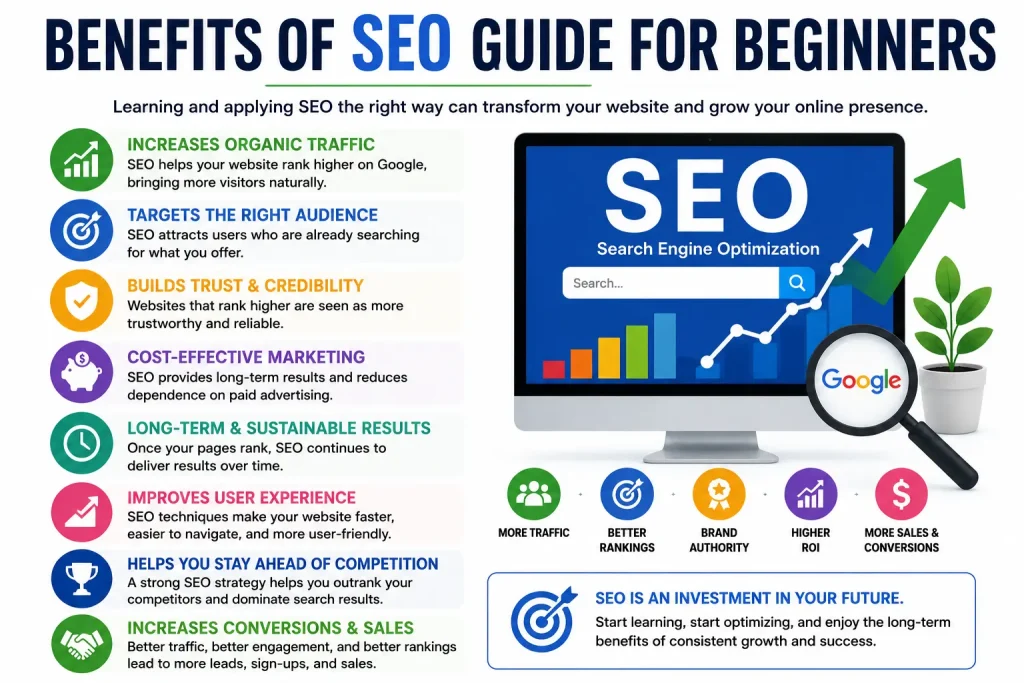
Learning SEO offers many long-term advantages:
- Increases organic traffic
- Builds brand credibility
- Generates consistent visitors
- Improves user experience
- Reduces marketing costs
- Supports business growth
- Creates long-term visibility
- Improves website authority
- Increases lead generation
- Delivers sustainable results
- Helps compete with larger websites
- Strengthens online reputation
Disadvantages / Risks
Although SEO provides excellent long-term benefits, it also has challenges.
Some common risks include:
- Results take time
- Search engine algorithms change regularly
- High competition in many industries
- Poor SEO practices can reduce rankings
- Requires consistent effort
- Technical issues may affect performance
- Low-quality backlinks can harm authority
- Outdated content may lose rankings
Understanding these risks helps create realistic expectations.
Common Mistakes to Avoid
Many beginners make avoidable SEO mistakes.
Some of the most common include:
- Keyword stuffing
- Publishing duplicate content
- Ignoring search intent
- Writing only for search engines
- Forgetting image optimization
- Poor website navigation
- Slow loading pages
- Missing title tags
- Weak meta descriptions
- Broken internal links
- Not updating old content
- Ignoring mobile optimization
- Buying low-quality backlinks
- Publishing thin content
- Skipping keyword research
Avoiding these mistakes creates a stronger SEO foundation.
How long does SEO take to show results?
SEO usually takes between three and six months before noticeable improvements appear. Highly competitive industries may require even more time. Consistency is the key to long-term success.
Is SEO free?
Organic SEO does not require payment for search engine rankings. However, you may invest in tools, content creation, website improvements, or professional services to achieve better results.
Can beginners learn SEO?
Yes. Anyone can learn SEO by understanding the basics, practicing regularly, and staying updated with search engine best practices. Experience improves your skills over time.
What is the difference between SEO and paid advertising?
SEO focuses on earning organic traffic through optimization, while paid advertising places your website in sponsored search results for a fee. SEO often delivers more sustainable long-term value.
How often should I update my content?
Review important pages every few months. Refresh outdated information, improve readability, add new insights, and ensure accuracy to maintain strong rankings.
Are backlinks still important?
Yes. High-quality backlinks from trusted websites continue to be an important ranking factor. Focus on earning natural links through valuable content rather than using manipulative tactics.
Expert Tips & Bonus Points
To improve your SEO results even further, keep these practical tips in mind:
- Always write for people before search engines.
- Focus on one primary keyword per page.
- Use secondary keywords naturally.
- Publish fresh, informative content consistently.
- Improve page speed whenever possible.
- Monitor analytics regularly to understand visitor behavior.
- Optimize every image before uploading.
- Update older articles to keep them relevant.
- Create clear calls to action for readers.
- Build trust by providing accurate and valuable information.
- Maintain a logical site structure that makes navigation easy.
- Be patient, as SEO success grows steadily over time rather than overnight.
Conclusion
Learning SEO may seem challenging at first, but every successful website starts with the same fundamentals. By following this SEO Guide for Beginners, you can develop a strong understanding of how search engines work and what users expect from high-quality content. From keyword research and on-page optimization to technical improvements and link building, each step contributes to better visibility and long-term growth.
Remember that SEO is not about finding shortcuts or manipulating search engines. Instead, it is about creating valuable content, delivering an excellent user experience, and continually improving your website. Small, consistent improvements often produce significant results over time.
As you gain experience, keep monitoring your performance, updating your content, and adapting to changes in search engine algorithms. With patience, persistence, and a commitment to quality, SEO can become one of the most effective ways to attract visitors, build credibility, and grow your online presence. Whether you manage a personal blog, a business website, or an e-commerce store, applying these proven SEO principles will help you establish a solid foundation for lasting digital success.
